A common thread: Drs. Patricia and Arthur Clements advance the study of women’s history and women’s health
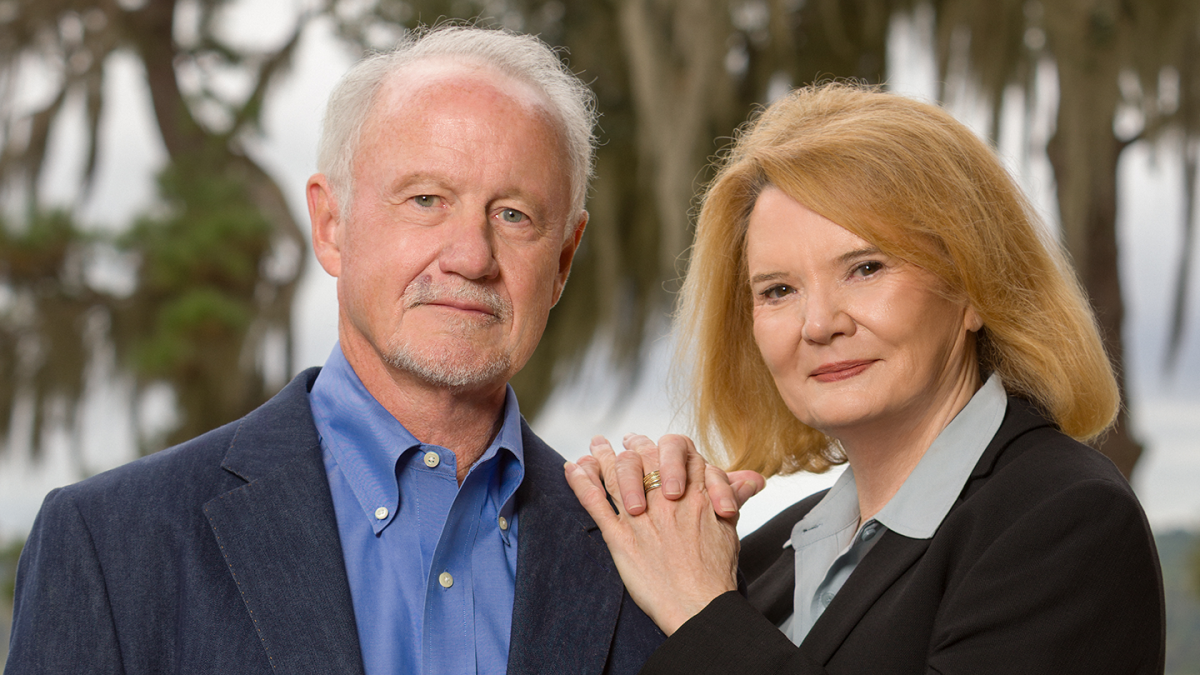
In Tallahassee and across Florida, a historical preservationist conserves women’s voices and a physician-educator builds teams that advance women’s health. Together, Patricia “Trish” and Arthur Clements have spent a lifetime making an impact in the fields of women’s history and women’s health.
By
Melissa Powell
Publication Date
Share
Their story began at the University of Florida as undergraduates. They met on a tennis date, which was the idea of a mutual friend who suspected they’d connect. It turned out she was right.
Arthur, in his own words, “went to the court and practiced like a maniac,” and Trish showed up ready to play. It’s a fitting scene for a partnership built on preparation, purpose, and shared focus. Arthur was awarded the Anne’s College Distinguished Alumni Award in 2025, and Trish received the same award in 2018. The Clements are the only couple in Anne’s College history to both receive Distinguished Alumni Awards.
When Trish and Arthur talk about their work, they share a similar outlook: build, preserve, lead, and listen. The habits they admire in each other, like preparation, integrity, and steadiness, are evident in everything from Trish’s statewide textile collection of Florida’s first ladies’ gowns to Arthur’s modern team-based model for a women’s healthcare medical practice.
After getting married in Miami, Trish’s hometown, they came to Anne’s College for graduate school. Trish earned her Ph.D. in Higher Education. Arthur earned his Ph.D. in Clinical Nutrition from the Department of Health, Nutrition, and Food Sciences.
Both Trish and Arthur are largely successful in their own right. Trish taught at El Instituto Tecnológico de Monterrey as well as the University of New Orleans, then built a career as a historical preservationist. She has spent over three decades preserving Florida’s political history and documenting the stories of women who helped shape it. She served as Chair of the Florida Commission on the Status of Women and was a member of the Founding Committee for The Women’s Park in Miami-Dade County, the first park dedicated to women in the United States.
Arthur founded North Florida Women’s Care in 1985, which is the largest women’s healthcare provider in the Big Bend. Arthur served twice as chair of Obstetrics and Gynecology at Tallahassee Memorial Hospital, was president of the Florida Obstetrics and Gynecology Society, and was president of Section 6 of the American College of Obstetricians and Gynecologists. Most meaningful, he says, has been his work with the FSU College of Medicine since its inception in 2000.
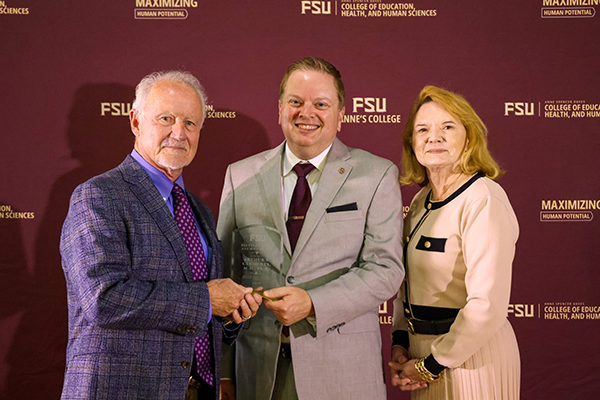
Arthur & Trish Clements with Dean Damon Andrew at the Anne's College Distinguished Alumni Awards (February 2025).
The nutrition spark
Arthur’s path to Nutrition and Food Science at FSU began with a jolt in an undergraduate clinical nutrition classroom at UF. “I had a high-energy professor who jumped on his desk. It was like we were in a movie. I thought the course was unbelievable,” Arthur said. “Nobody in biology was talking about nutrition or homing in on modern-day health. I thought, ‘This is it, this is a career.’”
He credits his Ph.D. experience with “catapulting” him toward his focus on women’s health, longevity, and quality of life. “The Department of Food and Nutrition was outstanding and supportive. It was just a machine – everybody was sticking together and working on their goals, which produced some outstanding results.”
During graduate school, he worked at an extended care facility, further sharpening his focus on women’s health. “I noticed that about 90-plus percent of people there were female and outliving the men, and I thought, ‘What’s going on here?’ So, I started to look at the longevity of the women there, and many were struggling with osteoporosis and sarcopenia, and nobody was really talking about that except FSU.”
A home in healthcare
After FSU, Arthur went to the University of Monterrey for medical school, and then to Tulane’s Charity Hospital for residency, where he served as chief resident in Obstetrics and Gynecology. When he returned to Tallahassee, he joined his father, Dr. Merritt R. Clements, an OB/GYN and one of the founding physicians of Tallahassee Memorial Hospital.
Arthur was born and raised in Tallahassee, but he never anticipated following a similar path as his father. Growing up, he saw firsthand the intensity of the demand required to work in labor and delivery.
“The technology we have today was inconceivable, especially in terms of synchronous communication via smartphones, yet the immediate access to physicians was just as strong of a demand decades ago as it is today,” he said. “No one in our family was allowed to speak on the phone for more than about four minutes in case someone was calling my father, and this was particularly hard for my sister,” he laughed. “But then you go through the rotations in medical school, and it’s just a natural gravitational pull.”
Building a medical school
When the Florida legislature authorized a new medical school at FSU in 2000, Arthur saw an extraordinary opportunity to shape how future physicians learn about women’s health, healthcare teams, and disease prevention.
“At the time, it was the most outstanding, unthinkable thing,” he said. “Here we are in relatively small Tallahassee, and we’re opening the country’s first new medical school in 20 years.”
Arthur was actively involved in the creation and opening of the FSU College of Medicine. Dean Ocie Harris and Dean Alma Littles charged him with developing the third-year medical student OB/GYN clerkship curriculum. Arthur was responsible for recruiting and hiring local faculty. “Those were some of the most outstanding memories of my career. I enjoyed developing future clinicians who would be leaders in medicine, especially those whom I mentored to pursue OB/GYN.”
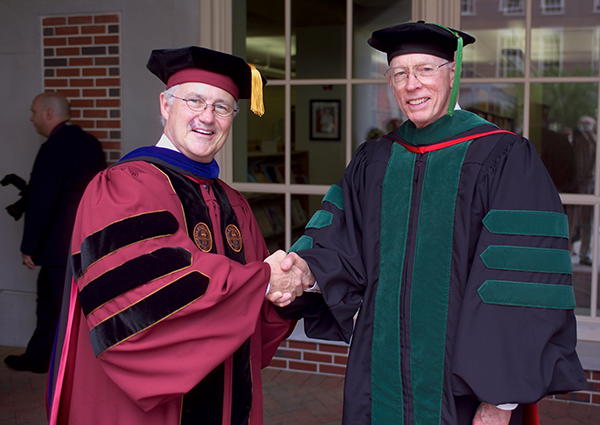
Arthur Clements and FSU College of Medicine Dean Ocie Harris attend the College of Medicine's first commencement ceremony (2005).
While maintaining his private practice, he served as the founding OB/GYN Clerkship Director for five years, then was asked to serve as the interim OB/GYN Education Director across the medical school’s six regional campuses, a position he held for two years.
Inside the clinic and the classroom, Arthur initiated a culture shift toward a team-based medical model that he views as his legacy at North Florida Women’s Care.
“Every person on the healthcare team matters and has to feel like they’re making a difference,” he said. “From the front office, the people who greet you, nurses, doctors, the cleaning crew, everybody has to show respect for each other.”
Trish describes Arthur as a clear-eyed natural leader who prioritizes the well-being of all. “He considers his entire medical practice, the needs of the medical team, and the students he's taught before he contemplates his personal goals,” she said. “Sometimes, when he tells me things, I'll say, ‘Arthur, what about Arthur Clements? You haven't even told me anything about you in this huge plan that you're going to execute,” she said with a smile. “So that is something I admire immensely.”
Fittingly, his clinical North Star is deceptively simple because it centers on listening to others.
“One of our lead professors in surgery at Tulane used to say, ‘if you listen to a patient long enough, they will tell you what their diagnosis is, and if you listen even longer, they will tell you how to treat them,’ so I do, and they’ll acknowledge that you’re actually hearing what they’re saying.”
An enduring passion for nutrition
Throughout his career, the nutritional thread that began at FSU was integral to the way he practiced medicine. People are now more aware of the importance of nutrition, he says.
“Research suggests it takes about 30 years for health-related trends or habits to change, such as with smoking or using seatbelts. We’ve been consuming high-fructose corn syrup since sugar was rationed during WWII, and now nutritionists finally have an audience,” he said. “The impact of gut health and the microbiome has been a topic of discussion among health professionals for 15 years or more. And now it’s receiving real public attention. Changes are taking place.” He believes nutrition will continue to rapidly evolve and make a significant difference in women’s health.
Preserving women’s voices
While Arthur advanced the science and practice of women’s health, Trish worked to elevate women’s history within Florida’s history, making sure that the women who built, influenced, and sustained communities are not lost to time.
“I view women as the prime movers of society,” she said. “They inspire and encourage those around them to achieve and reach their greatest potential.
“Women have safeguarded the generational records of the family’s accomplishments by preserving critical documents, photographs, artifacts, and sentimental clothing from the milestones of life. It’s logical to work with them to obtain accurate data that often didn’t appear in archives, libraries, or museums prior to this interest in scholarship."
From rhetoric to research
Trish began her academic journey studying rhetoric and public address, earning her master’s degree with a focus on how people use speech to persuade, inspire, and lead. “Then I transitioned into education, thinking it would offer me a wider range of choices. I wanted to analyze other people’s work as well as have an opportunity to do my own.”
That decision to create rather than critique became a defining theme.
“The skills I developed while conducting my dissertation research enabled me to become a critical thinker. I apply this critical analysis as I gather facts, data, and statistics from The Florida Archive and the Florida State Library,” she said. “The process gives me a non-sentimental view of whatever problem I'm trying to assess.”
Trish’s impact on Florida’s historical record is tangible and profound, spanning interviews with world leaders, a Nobel Prize-winning physicist, and curating artifacts for future generations.
In addition to serving as Chair of the Florida Commission on the Status of Women, she served as Chair of the Florida Women’s Hall of Fame. “I realized there are so many women who are not recognized for what they've done. The Hall of Fame inspires young women and girls by recognizing and celebrating diverse achievements of women from all walks of life.”
One of her proudest initiatives is the Florida First Ladies’ Gown Collection, founded in 1996 and now permanently housed at the Museum of Florida History in Tallahassee. Donating her own research, personal time, and resources, Trish served as the appointed history liaison to the Florida Department of State. The collection comprises more than 100 artifacts that trace the evolving role of women as political partners.
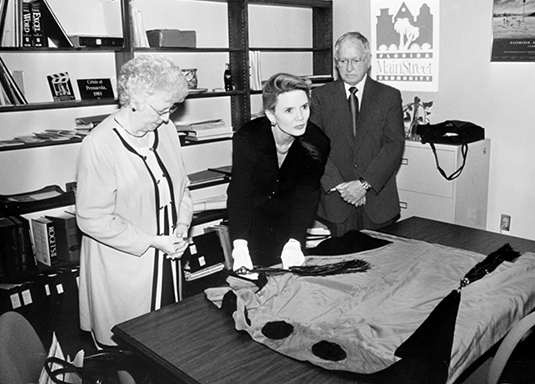
Trish Clements receiving the inaugural gown of First Lady Maude Hardee.
Her motivation wasn’t about fashion, but symbolism. “It’s not just about gowns. It’s about culture. Clothing is an integral part of cultural rituals. As individuals and as a collective, women work to reinforce or challenge certain cultural norms. You're supposed to wear something specific to a funeral, a wedding, a campaign event, or an inauguration, for example. Each culture defines what is appropriate, and women have driven the decision-making process.”
The power of voice
In 2005, she authored A Legacy of Leadership: Florida Governors and Their Inaugural Speeches, which stands as Florida’s oldest oral history project. The book also serves as a time capsule for the evolution of rhetoric, governance, and civic ideals in the state.
Her oral history work has captured the voices of Florida’s first ladies and governors as well as Cuban exiles who attempted to free their country in a 1961 invasion known as the Bay of Pigs. “Contemporary history told by those who experienced an event has true gravitas. Hearing first-hand accounts promotes intellectual curiosity,” she said.
Her philosophy of preparation and balance extends to every part of her life. Arthur describes her as “righteous, steadfast, consistent,” and always “overprepared.” She nods and agrees. “When you’ve given your best, you have no more to give,” she says with a smile. “So, there’s no reason to wonder. If you really threw down, then that’s it, right?”
They applied a similar sense of steadiness to the way they balanced their careers and family raising two daughters, Claire and Meredith. “Your job is not your life. Work hard, but put your family first,” she said. Claire Clements is a grant writer for Tallahassee Memorial Hospital, and Meredith Merlau is an associate professor of communication at the University of Tampa.
Advice for the next generation
When asked what advice they would give to today’s students, Trish stresses the importance of continuity. “Pick a field in which you excel. Plan your goals in one-year increments. You can go in many directions, but maintain a thread of continuity,” she said. It’s advice rooted in her own journey, one that has linked rhetoric, research, preservation, and leadership into an enduring legacy. “Make accurate assessments of your abilities, and of those who work with you,” she said.
Conviction ties together the lives and legacies of Trish and Arthur Clements. In their work, teaching, and service, they remind students that a lasting impact is cumulative: choose your lane, do the work, mentor others, and maintain a common thread.
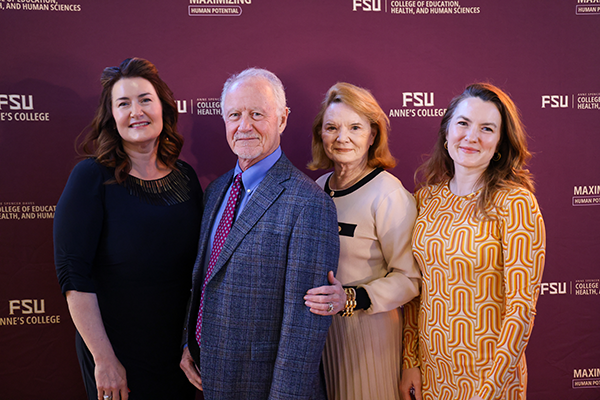
From left to right: Claire, Arthur, Trish, and Meredith Clements.